Why Beginners Lose at Fishin Frenzy — and How the Game Actually Works
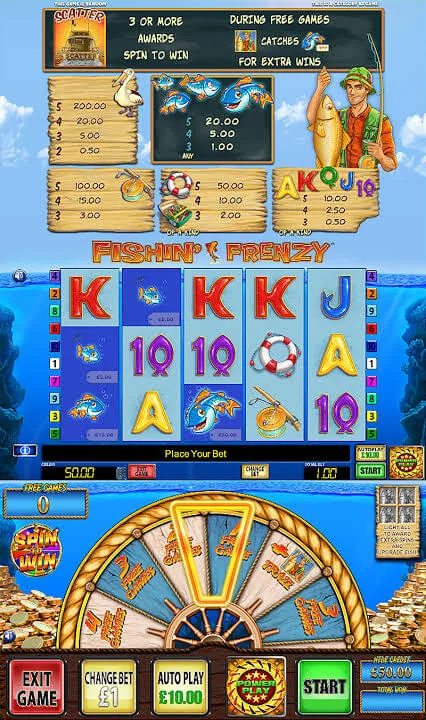
The most expensive mistake a Fishin Frenzy beginner makes is staking £5.00 per spin in the base game, watching the fisherman wild land a dozen times, and wondering why nothing happens. The fisherman does nothing outside free spins — he's decoration until you trigger the boat scatters. That one misunderstanding has cost more bankroll than any other feature in Blueprint Gaming's catalogue.
Fishin Frenzy is a 5-reel, 10-payline slot that has sat in every UKGC-licensed lobby since Blueprint released it over a decade ago. It returns 96.12% to players over millions of spins, carries medium volatility, and pays up to 5,000× your stake if you land enough fish symbols during the free-spins round. The whole game hinges on three or more boat scatters unlocking 10 free spins, at which point the fisherman wild starts collecting the cash values printed on every fish symbol visible on the reels. Miss that mechanic and you'll burn through your deposit wondering why the cartoon angler on reel three never pays you a penny.
Where Fishin Frenzy came from — and why it never left UK lobbies
Blueprint Gaming built Fishin Frenzy in the early days of HTML5 slots, when most studios were still porting Flash games to mobile. The premise was simpler than anything else on the market: a fisherman, some fish with cash tags, and a free-spins round where he collects the lot. No cascades, no multiplier ladders, no buy-bonus upsell. Just ten paylines and a mechanic you could explain in a sentence.
It caught on because it ran smoothly on every device the UK Gambling Commission licensed, from desktop Firefox to budget Android browsers, and because the free-spins trigger rate felt fair — you'd see the boats often enough to stay interested, but not so often that the game bled value. Medium volatility meant you could play 200 spins on a £20.00 deposit without hitting empty, and the 96.12% RTP sat comfortably above the 94–95% floor most operators were offering at the time.
Blueprint has since released two dozen sequels — Fishin Frenzy Megaways, The Big Catch, Prize Lines, Jackpot King variants — but the original still accounts for more UK spins than any of them. You'll find it on every licensed site that carries Blueprint's catalogue, and the reason it stayed there is the same reason it arrived: it works, it's stable, and players who tried it once tend to come back.
How a round works from your seat — base spins, scatters, and the free-spins mechanic
You choose a stake between £0.10 and £100.00 per spin, though the £5.00 cap applies if you're playing on a UKGC-licensed site (£2.00 if you're aged 18–24). All ten paylines are active; you're setting total bet, not line bet. Click spin and the reels stop independently, left to right. Matching symbols on a payline from reel one pay out according to the paytable — the pelican is top at 500× line bet for five, the rod and tackle box come next, then the standard 10-through-A card ranks.
The fisherman wild substitutes for everything except the boat scatter. If he lands on reel three during base spins, he does nothing beyond completing paylines. The fish symbols carry cash values — 2×, 5×, 10×, 15×, 20× your total stake — but those values are inert until free spins start. This is where beginners haemorrhage deposits: they see the fisherman, they see the fish, they assume something's about to pay, and they keep spinning at maximum stake waiting for a collection that will never happen.
Three, four or five boat scatters anywhere on the reels trigger 10, 15 or 20 free spins. The moment the round starts, every fish symbol that lands shows its cash value, and every time the fisherman wild appears he collects the sum of all visible fish on that spin and adds it to your running total. The free-spins round cannot retrigger — you get your allocation and the round ends. If you land 12 fish symbols across ten spins and the fisherman appears on six of them, you collect the values six times over. If the fisherman never appears, you collect nothing from the fish and rely on standard payline wins to carry the round.
What the numbers mean — stake caps, RTP, volatility, and the 5,000× ceiling
RTP of 96.12% means that for every £100.00 wagered across millions of spins, the game returns £96.12 to players as winnings. You will not see that ratio in a single session; variance determines whether your fifty spins return £5.00 or £150.00, and medium volatility means you should expect runs of ten to twenty dead spins followed by a scatter trigger that either recovers your outlay or falls short.
The maximum win is 5,000× your total stake, which translates to £500.00 on a £0.10 spin or £25,000.00 on a £5.00 spin (the UKGC cap). Some versions of the game show a £250,000.00 absolute ceiling, but that figure only applies to operators running higher-stake variants outside the UK market or to older regulatory windows; under current UKGC rules the £5.00 per-spin cap limits your maximum single-round win to £25,000.00. If you're aged 18–24 and subject to the £2.00 cap, your ceiling is £10,000.00.
Medium volatility means the game sits between low-variance slots that pay small amounts frequently and high-variance games that pay rarely but heavily. In practice, you'll trigger free spins roughly once every 80–120 spins, and most of those rounds will return between 10× and 50× your stake. The 5,000× maximum requires a near-perfect free-spins round: high-value fish on every spin, the fisherman landing on most of them, and favourable RNG throughout. It happens, but not often enough to plan a session around it.
Where to play legally — UKGC sites, demo access, and what to check before deposit
Every operator serving British players must hold a remote gambling licence issued by the UK Gambling Commission. The licence number sits in the footer of the site, usually alongside links to GAMSTOP and BeGambleAware. You can look up the operator in the UKGC public register and verify that the licence is current and covers casino games; unlicensed sites are illegal to advertise or operate here, and you have no recourse if they refuse to pay out.
Fishin Frenzy appears in most lobbies that carry Blueprint Gaming's catalogue. Examples on the UK market include BetVictor, Casumo, and SlotsMagic, though availability shifts as operators rotate their game libraries and Blueprint negotiates distribution. These are examples, not endorsements — check the UKGC register yourself and read the operator's terms on withdrawal times, affordability checks, and bonus wagering requirements before you deposit.
Demo play is common on UKGC sites, though many operators restrict free play to logged-in accounts that have completed age verification. The demo runs on the same RNG and RTP as the real-money version, so the hit rate and feature frequency are identical; the only difference is that demo winnings are virtual and you cannot withdraw them. If the site offers demo access without login, you're either on an unlicensed platform or in a jurisdiction where age gates are handled differently — check the footer for the UKGC licence number before you assume it's legitimate.
| Operator example | Licence check | Demo available | Withdrawal method | |
|---|---|---|---|---|
| BetVictor | UKGC register + footer | Yes (logged in) | Faster Payments, e-wallet | → |
| Casumo | UKGC register + footer | Yes (logged in) | Faster Payments, PayPal | → |
| SlotsMagic | UKGC register + footer | Yes (logged in) | Faster Payments, Trustly | → |
Demo versus real money — identical RNG, zero financial risk, and why it still matters
The demo version of Fishin Frenzy uses the same random number generator and the same 96.12% RTP as the real-money game. The scatter trigger rate, the fish value distribution, and the fisherman appearance frequency are identical. If you play 500 demo spins and see 6 free-spins rounds, you should expect roughly the same frequency when you switch to real money — variance will shift the timing, but the long-run maths stay constant.
The value of demo play is mechanical fluency, not win prediction. You learn how the free-spins round feels when the fisherman lands on the first spin versus the last, you see how quickly a 10-spin round can drain when the fisherman doesn't appear, and you calibrate your stake to your tolerance for dead spins. That knowledge prevents the classic beginner mistake: depositing £50.00, setting a £5.00 stake, hitting ten losing spins in a row, and walking away convinced the game is rigged.
Demo winnings are virtual and cannot be withdrawn, converted, or carried over to real-money play. If you hit a 500× free-spins round in demo mode, you've learned what that round looks like and how rare it is — but the RNG state resets the moment you switch to real money, and your next session starts from scratch. Treat demo play as rehearsal, not prophecy.
Common mistakes and what they cost — stake caps, dead spins, and misreading the fisherman
The most expensive error is ignoring the £5.00 stake cap and expecting operators to let you spin at £10.00 or £20.00 per round. UKGC regulations cap online slot stakes at £5.00 for all players and £2.00 for anyone aged 18–24, and those limits are hard-coded into licensed sites. If you built your bankroll strategy around higher stakes, you'll need to recalibrate or switch to a game that allows them — though no UKGC slot will exceed the £5.00 ceiling.
The second mistake is misunderstanding the fisherman wild. He substitutes for payline symbols during base spins but does not collect fish values until free spins start. Beginners see him land on reel three alongside two fish symbols, assume they've won the displayed cash values, and keep spinning at maximum stake waiting for a payout that will never arrive. Read the paytable before you deposit — it explains exactly when the collection mechanic activates.
The third mistake is chasing losses after a weak free-spins round. Medium volatility means some rounds will return 5× your stake, others will return 80×, and a handful will return 500× or more. If your first trigger pays 12× and you double your stake hoping the next round will compensate, you're not playing the maths — you're gambling on variance, and variance does not care what you lost three minutes ago. Set a session budget, divide it into stakes that give you 100–200 spins, and stop when the budget runs out.
- Staking £5.00 per spin without understanding the dead-spin frequency — you'll burn £50.00 in ten spins if the scatters don't land.
- Assuming the fisherman collects fish values in the base game — he doesn't, and that misunderstanding costs more than any other feature confusion.
- Chasing a weak free-spins round by doubling your stake — the RNG does not owe you a recovery, and increasing your exposure after a loss is how deposits evaporate.
- Playing without checking the operator's UKGC licence number — unlicensed sites have no legal obligation to pay out, and you have no recourse if they refuse.
- Ignoring affordability checks once your deposits exceed £150.00 in a month — operators will ask for payslips or bank statements, and if you can't provide them your account will be restricted.
FAQ
What does the fisherman wild do in the base game?
He substitutes for payline symbols but does not collect fish values. The collection mechanic only activates during free spins, when every fish symbol displays its cash value and the fisherman gathers the total whenever he appears. Outside free spins, he's a standard wild with no special function.
How often do the boat scatters trigger free spins?
Medium volatility and a 96.12% RTP suggest a free-spins trigger roughly once every 80–120 spins, though variance means you might see two triggers in 50 spins or none in 200. The scatter frequency is governed by the RNG, not by how much you've wagered or how long you've played.
Can I play Fishin Frenzy above the £5.00 stake cap?
No. UKGC regulations cap online slot stakes at £5.00 per spin for all players, and £2.00 per spin for players aged 18–24. Those limits apply to every licensed operator serving British players, and there are no exceptions for high-roller accounts or VIP tiers.
Is the demo version identical to the real-money game?
Yes. The demo uses the same RNG, the same 96.12% RTP, and the same scatter and fish value distribution as the real-money version. The only difference is that demo winnings are virtual and cannot be withdrawn. Use it to learn the mechanics, not to predict outcomes.
What happens if I deposit more than £150.00 in a month?
Your operator will begin affordability checks, starting with automated credit-reference checks and escalating to requests for payslips, bank statements, or tax returns if your deposits continue to rise. This is a UKGC requirement, not an operator policy, and refusal to provide documents will result in deposit limits or account restrictions.
Where do I check if an operator is UKGC-licensed?
Look for the licence number in the site footer, then search the UK Gambling Commission public register to verify the licence is current and covers remote casino games. If the operator isn't listed or the licence has been suspended, do not deposit — unlicensed sites are illegal in the UK and you have no protection if they refuse to pay out.